JEE MainCollege Predictor 2026

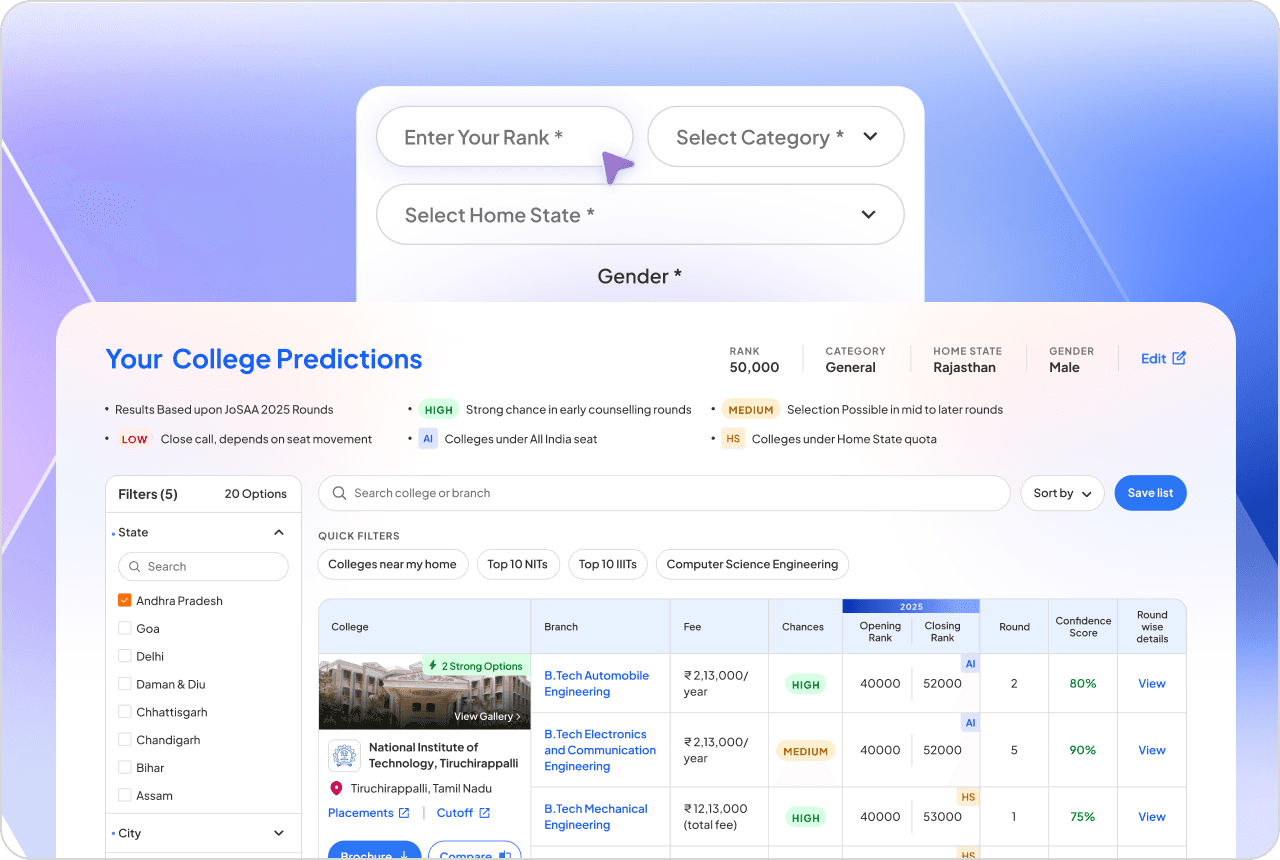
The JEE Main Cutoff Predictor 2026 is a free tool that helps candidates estimate their admission chances in NITs, IIITs, and GFTIs. It uses previous year JoSAA counselling data, opening and closing ranks, category-wise cutoffs, and seat availability to generate a personalised list of colleges. Candidates can enter their JEE Main rank or percentile, category, gender, and home state to get instant results. The predictor is based on the latest 2025 JoSAA counselling data and is updated for the 2026 academic session. It is important to note that this tool provides estimates based on historical trends. The final seat allotment depends on the actual JoSAA counselling process conducted by the Joint Seat Allocation Authority.

Get Your Best-Fit Colleges

See what's safe vs worth a shot
No sign up required
Data-backed predictions
All Colleges covered

Table of Contents

JEE Main 2026 Qualifying Cutoff – Category-Wise Expected Percentile

The qualifying cutoff of JEE Main is the minimum NTA percentile a candidate must score to become eligible for JEE Advanced. NTA releases this cutoff after the Session 2 results. For JEE Main 2026, the expected qualifying cutoff is based on previous year trends and the difficulty level of the Session 1 exam held from 21 to 29 January 2026.

The qualifying cutoff is different from the admission cutoff. The qualifying cutoff only decides eligibility for JEE Advanced. The admission cutoff is the opening and closing rank required for seat allotment in NITs, IIITs, and GFTIs through JoSAA counselling.

JEE Main Qualifying Cutoff – Previous Year Trends (2021–2025)

Category 2025 Cutoff (Percentile) 2024 Cutoff (Percentile) 2023 Cutoff (Percentile) 2022 Cutoff (Percentile) 2021 Cutoff (Percentile)
General (UR) 93.10 93.23 90.77 88.41 87.89
GEN-EWS 80.16 81.33 75.62 63.11 66.22
OBC-NCL 74.31 79.67 73.61 67.01 68.02
SC 60.09 60.09 51.97 43.08 44.25
ST 47.90 46.69 37.23 26.77 27.23
GEN-PwD 0.0018 0.0018 0.0013 0.0096 0.0003

The General category cutoff has shown a consistent upward trend from 87.89 in 2021 to 93.10 in 2025. This indicates rising competition every year. The SC and ST cutoffs have also increased significantly since 2021. Based on these trends, the expected General category cutoff for JEE Main 2026 is likely to be in the range of 93 to 95 percentile.

JEE Main 2026 Expected Qualifying Cutoff

Category Expected Cutoff Percentile (2026)
General (UR) 93 – 95
GEN-EWS 80 – 83
OBC-NCL 79 – 81
SC 60 – 65
ST 48 – 52

JEE Main Cutoff for NITs – Closing Ranks for Top NITs (CSE, General Category)

NITs are among the most sought-after engineering institutes in India after IITs. There are 31 NITs across the country. Admission to NITs is based on JEE Main All India Rank through JoSAA counselling. The cutoff varies by institute, branch, category, and quota (Home State or Other State). CSE and IT branches have the highest cutoff at most NITs due to strong placement records.

Candidates with a percentile above 99 have strong chances of securing CSE at top NITs like NIT Trichy, NIT Warangal, and NIT Surathkal. Those with 97 to 98.9 percentile can target mid-tier NITs. Candidates with a percentile between 90 and 96 may get seats in newer or lower-ranked NITs in branches like Civil, Chemical, or Metallurgy.

JEE Main 2025 Last Round Closing Ranks – Top NITs (B.Tech CSE, General, All India Quota)

NIT Name Closing Rank (General – Gender Neutral) Closing Rank (OBC-NCL) Closing Rank (SC) Closing Rank (ST)
NIT Trichy 2,476 1,200 870 385
NIT Warangal 3,813 1,650 1,020 520
NIT Surathkal 4,020 1,700 1,060 470
NIT Calicut 6,120 2,900 1,830 740
NIT Rourkela 7,100 3,400 2,100 870
MNIT Jaipur 7,500 3,600 2,250 920
NIT Allahabad 9,200 4,300 2,800 1,100
VNIT Nagpur 8,800 4,100 2,700 1,050
NIT Durgapur 12,500 5,800 3,600 1,400
NIT Silchar 18,000 8,200 5,100 2,200

Home State quota can give an advantage of 25% to 40% in closing ranks compared to Other State or All India quota. Candidates should check both quotas while filling choices during JoSAA counselling.

JEE Main Cutoff for IIITs – Closing Ranks for Top IIITs

IIITs or Indian Institutes of Information Technology are preferred by candidates aiming for software and AI-based careers. There are 26 IIITs participating in JoSAA counselling. Competition is very high for IIITs. The seat intake is lower compared to NITs. This makes the cutoff for IIITs higher than most NITs for CSE and IT branches. IIITs in metro cities have 25% to 30% higher closing ranks due to demand for tech jobs.

JEE Main 2025 Last Round Closing Ranks – Top IIITs (B.Tech CSE, General, All India Quota)

IIIT Name Closing Rank (General – Gender Neutral) Closing Rank (OBC-NCL) Closing Rank (SC) Closing Rank (ST)
IIIT Hyderabad 2,100 950 620 310
IIIT Allahabad 5,500 2,600 1,600 700
IIIT Delhi 5,200 2,400 1,500 650
IIIT Bangalore 4,800 2,200 1,400 600
IIIT Lucknow 9,800 4,600 2,900 1,200
IIIT Gwalior 11,500 5,500 3,400 1,500
IIIT Kottayam 16,200 7,500 4,800 2,000
IIIT Surat 18,000 8,400 5,200 2,300

JEE Main Cutoff for GFTIs – Closing Ranks for Government Funded Technical Institutes

GFTIs or Government Funded Technical Institutes offer more accessible options compared to NITs and IIITs. These include institutions like IIEST Shibpur, BIT Mesra, IIITDM Jabalpur, and others. The cutoff varies significantly based on location, branch, and institute reputation. GFTIs are a good option for candidates with JEE Main ranks between 20,000 and 70,000 in the General category. The SC and ST cutoffs are approximately 40% to 45% lower than General category ranks.

JEE Main 2025 Last Round Closing Ranks – Select GFTIs (B.Tech CSE, General, All India Quota)

GFTI Name Closing Rank (General – Gender Neutral) Closing Rank (OBC-NCL) Closing Rank (SC) Closing Rank (ST)
IIEST Shibpur 8,500 4,000 2,500 1,000
BIT Mesra (Ranchi) 16,000 7,200 4,500 1,900
IIITDM Jabalpur 14,500 6,800 4,200 1,800
IIITDM Kancheepuram 15,200 7,000 4,400 1,850
Sant Longowal Institute 52,000 24,000 15,000 6,500
Gurukula Kangri Vishwavidyalaya 70,000+ 32,000 20,000 8,500

Candidates with a rank above 70,000 can still get seats at less popular GFTIs. The Home State quota and lower-demand branches like Mechanical, Civil, and Chemical Engineering can further improve admission chances at these institutes.

JEE Main Marks vs Percentile – Expected Range for 2026

JEE Main scores are normalised and reported as NTA percentile, not raw marks. The same marks can give different percentile in different years based on difficulty level and candidate performance. The table below gives an approximate range of marks and the corresponding percentile based on recent trends.

Marks Range (out of 300) Expected Percentile Range Possible College Tier
250 – 300 99.5 – 100 Top 5 NITs (CSE), IIIT Hyderabad
200 – 250 98 – 99.5 Top 10 NITs, Top IIITs
170 – 200 96 – 98 Mid-tier NITs, IIITs (CSE/IT)
140 – 170 92 – 96 NITs/GFTIs (Mechanical, EE, Civil)
100 – 140 85 – 92 Lower NITs, GFTIs, State Colleges
70 – 100 75 – 85 Select GFTIs, State-level Colleges
READ MORE

How the Predictor Works

How the Predictor Works
STEP 1

Data Collection and Analysis

The predictor collects and analyses JoSAA opening and closing rank data from the last 3 to 5 years. This includes round-wise cutoff data for all participating NITs, IIITs, and GFTIs. The tool maps rank ranges to specific institutes, branches, categories, and quotas. It also accounts for year-on-year trends in cutoff movement and seat availability changes.

STEP 2

Personalised Matching Based on Candidate Profile

The candidate enters their JEE Main rank or percentile, category (General, OBC-NCL, SC, ST, EWS, PwD), gender, and home state. The predictor uses this profile to filter results based on applicable quotas. It considers both All India quota and Home State quota options. Female candidates are matched with both Gender-Neutral and Female-Only seat pools.

STEP 3

College List Generation with Probability Indicators

The tool generates a personalised list of colleges and branches sorted by admission probability. Colleges are marked as high chance, moderate chance, or low chance based on how the candidate's rank compares with previous year closing ranks. This list helps candidates plan their JoSAA choice filling strategically and avoid missing out on better options.

Mistakes
to avoid during the Counselling

warning

WHY IT'S RISKY

  • JoSAA doesn't consider college popularity - only rank + availability
  • If no choice matches your rank, you get no seat at all
check

WHAT TO DO

  • Fill a mix of safe, competitive, and stretch options.
warning

WHY IT'S RISKY

  • Each category has different cutoff ranks for the same college
  • General category students compete in the largest pool with higher cutoffs
check

WHAT TO DO

  • Check past year cutoffs for your specific category
  • Use category-specific predictors for accurate results
warning

WHY IT'S RISKY

  • Home state quota can significantly lower your required rank
  • Missing this can lead to choosing less preferred colleges
check

WHAT TO DO

  • Always check home state quota cutoffs
  • Prioritize colleges in your home state if they match your preferences
warning

WHY IT'S RISKY

  • Some colleges have separate seats for female candidates
  • Female candidates may have better chances at certain colleges
check

WHAT TO DO

  • Check if colleges offer gender-specific seats
  • Use gender-specific predictors for accurate predictions
warning

WHY IT'S RISKY

  • Choosing colleges without understanding placement, location, or fees
  • May end up in a college that doesn't match your career goals
check

WHAT TO DO

  • Research each college thoroughly before adding to choices
  • Consider placement records, location, fees, and infrastructure
warning

WHY IT'S RISKY

  • Cutoffs change after each round based on seat availability
  • Not updating can lead to missing better opportunities
check

WHAT TO DO

  • Review and update your choices after each round
  • Use updated cutoff data to refine your preferences
Need Help in Understanding the Process?

Get one-on-one guidance to avoid common mistakes in choice filling, understand your best options, and plan your preferences with confidence.

The Logic Behind Seat Allocation

Category

Category

Seats are divided among categories as per Government of India reservation norms. The seat distribution is 27% for OBC-NCL, 15% for SC, 7.5% for ST, and 10% for EWS. The remaining seats fall under the General (Open) category. Each category has its own rank list. Open seats use the Common Rank List (CRL). OBC-NCL, SC, ST, and EWS seats use their respective category rank lists. A reserved category candidate with a good enough CRL rank is first considered for Open seats before being allocated a seat from their own category pool.


Rank

Rank

Quota

Quota

Gender

Gender

How does the Counselling Process Works?

Registration on JoSAA Portal

01

  • The Joint Seat Allocation Authority (JoSAA) conducts the centralised counselling for admission to IITs, NITs, IIITs, and GFTIs.
  • For the 2025–26 academic session, JoSAA managed admissions for 127 institutes including 23 IITs, 31 NITs, IIEST Shibpur, 26 IIITs, and 47 GFTIs.

Choice Filling

02

  • After registration, candidates select their preferred combinations of institute and course.
  • They can choose from all participating institutes based on their eligibility.
  • Choices must be arranged in order of preference. The first choice should be the most preferred option.
  • JoSAA allows candidates to fill a large number of choices.
  • andidates should fill as many choices as possible to maximise their chances of getting a seat.

Mock Seat Allotment

03

  • JoSAA provides 2 mock seat allotments before the actual allocation. These are trial rounds that show candidates what seat they would get based on their current preferences.
  • Mock allotments help candidates review and adjust their choices. Candidates can add, remove, or rearrange choices based on mock results.

Choice Locking

04

  • Before the deadline, candidates must lock their choices. Once locked, no changes are allowed.
  • If choices are not locked manually, the last saved choices are considered final for the actual seat allotment rounds.
  • Candidates should review their choice list carefully before locking.

Seat Allotment (Multiple Rounds)

05

  • JoSAA conducts 6 rounds of seat allotment. In each round, seats are allocated based on the candidate's rank, locked choices, and seat availability.
  • If a candidate is allotted a seat, they must respond by choosing one of the following options: Freeze (accept the seat and do not participate in further rounds), Float (accept the seat but try for a higher preference in subsequent rounds), or Slide (accept the seat but try for a better branch in the same institute in subsequent rounds).

Seat Acceptance Fee Payment

06

  • After seat allotment, candidates must pay the Seat Acceptance Fee (SAF) within the deadline. For General/OBC/EWS candidates, the fee is Rs 45,000.
  • For SC/ST/PwD candidates, the fee is Rs 15,000.
  • Failure to pay the fee leads to cancellation of the allotted seat.
  • The fee is later adjusted against the admission fee at the institute.

Document Verification and Reporting

07

  • Candidates must upload required documents on the JoSAA portal for verification.
  • hese include Class 10 and 12 marksheets, category certificates (issued on or after April 1 of the current year for OBC-NCL and EWS), PwD certificate, identity proof, and bank account details.
  • The reporting authority verifies the documents and confirms the seat.
  • Any discrepancy in documents can lead to seat cancellation.

CSAB Special Rounds

08

  • After 6 rounds of JoSAA counselling, any vacant seats in NITs, IIITs, and GFTIs are filled through CSAB (Central Seat Allocation Board) special rounds.
  • IIT seats are not included in CSAB rounds.
  • Candidates who did not get a seat or want to upgrade can participate in CSAB special rounds for remaining seats.
whatsapp

Chat with us